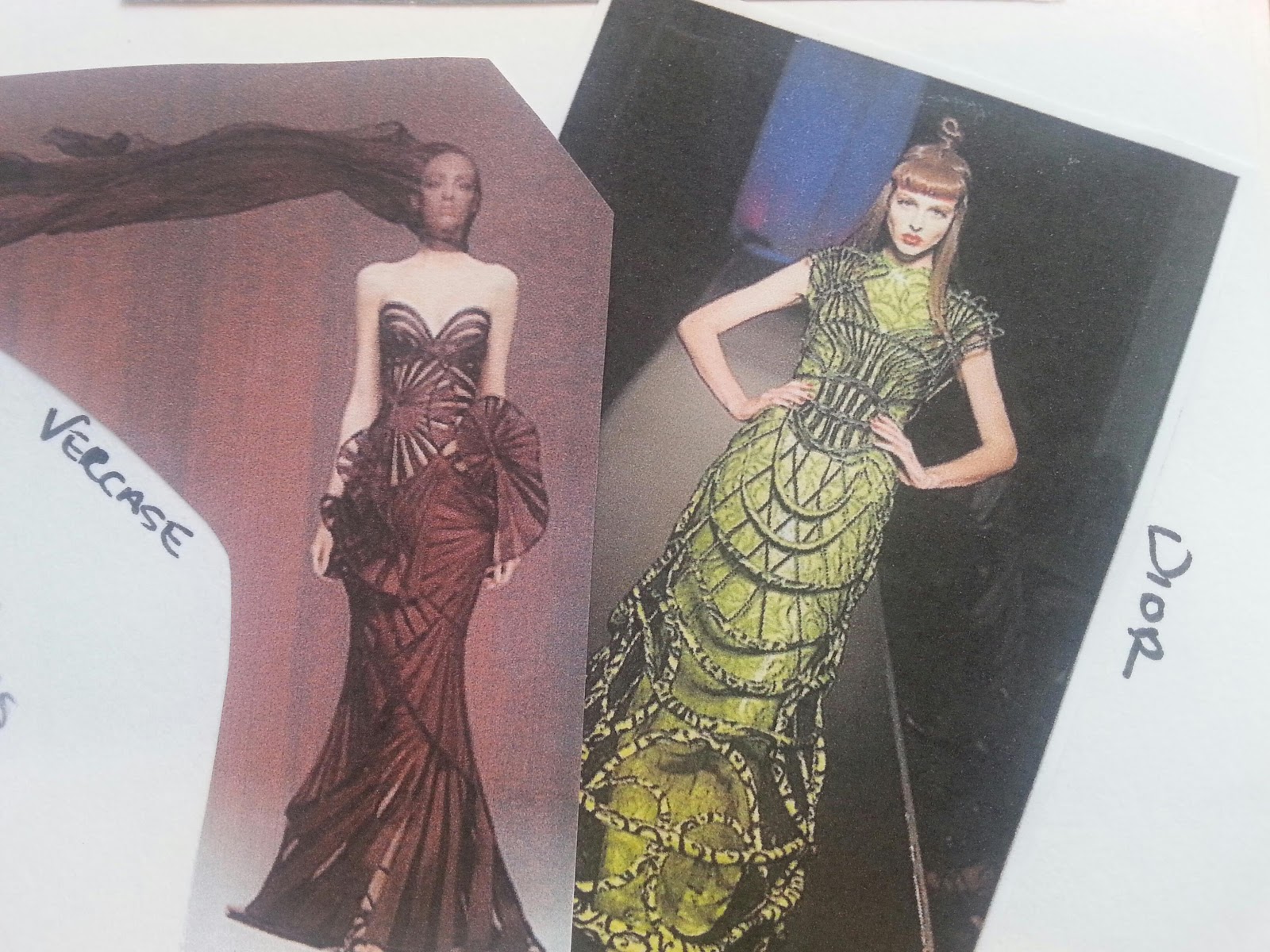
Tuesday, 19 March 2013

Essay

BBC The LOOK - Material World on Vimeo
Lacroix said he loved the accidental errors that can happen when producing garments entirely by hand. it makes the peice more magical more organic and more individual.
The practice of one off pieces does not help to support the cottage industries that produce the painstakingly hand made fabrics  the fact that only one or two will ever be made and that next season that crafted fabric style will no longer be on trend means that the companies that produce these exquisite fabrics may not be financially supported enough to carry through to the new decade. History is forgotten and fashion has moved on.
Fabric adds to the movement of the body, it needs to compliment the movement and add to. The starting point for design should be the body.
Fashion design should suit everyone but be challenging.  Issey miyake and his fabric designer beleive this and it shows within his designs. Clothes that are practical yet revelutionary. He uses his couture background and education to produce clothes that are easy to wear without forgetting the craftsmanship and the art. Practical art.

Monday, 18 March 2013

Major Project - waistcoat and skirt

I have drafted the first toile pattern for the skirt and waistcoat.  I will need to cut it out in fabric and make up the toiles as there are a few things bothering me:

The Skirt:
I have concerns about how I am going to add a large origami structure to the front of the skirt and still make it look like a layered wrap skirt

The Waistcoat:
I don't yet know the best way to make the waistcoat back design or which design to use for the finished garment
I will also need to buy some interfacing before I can make up the toile to ensure the structure is true to the finished look

I have decided to make the toile up and then ask a few people for feedback and see what will work in reality.

Major Project - Drafting the shift dress

I cinpleted tgw pattern for the dress snd made it symetrical left to right, instead of off the shoulder. I have also decided to add my version of budellini by covering piping in the printed jersey and weaving it to form a cage kike structure at the bottom of the dress.
This will need to be considered for elegance and high quality.  I will need to pull on my skills from working on army dress uniform cording to ensure the best quality finish

Major Project - design development skirt

I have been looking at the waistcoat I have designed and thinking about what to design to go with it and I want to design a skirt, something that fits comfortably but can be worn dressed up or down. I am going to use a layering effect that mirrors the kines element but also holds the layers of origami
Need to design a skirt
Need to keep it layered or add origami
I have looked through my sketch book to gain ideas and decided to develop the layered designs I sketched over christmas. 
After plenty of developing and thinking through of construction I have the following designs

A basic but developed wrap skirt, the idea was taken from a skirt I saw when I visited Thailand, a sarong style skirt that could be used for by the pool and equally for an evening out. I like the idea of it being comfortable yet stylish.
Now I need to create the pattern and toile.

Thursday, 14 March 2013

Major Project - Designing

I have carried out some design development and I like where it is going. I have developed it into a waistcoat. I like the one that simple has one fold at the back, I will need to starch the fabric and it will need to be lined as the inside of the fabric is the one that is seen at the back.
I will also need to think of colour, my colour palette is dirty pink, grey and a maroon, with the blues that come from the dying process too.
I need to design an item of clothing that goes with this top.
Trousers maybe or a skirt

Major Project - Dying the fabric

I have died some fabric today. I decided to use the crinkle dye process, this process means you scrunch up your fabric, giving it as many folds and lines as possible. You then push it into a small container, the smaller the better.
You place a small amount of dye into a cup and pour it down the side of the container that holds the fabric. you then weight down the fabric and wait about 3 hours, you then rinse and dry it ready for a second colour or application.
I like this process, but want to see if I will need to dye the fabric before cutting the pattern pieces or dying the pattern pieces. I will see how it works when I starch the fabric and try and fold it.

Final Major - Design development


Looking back through my sketchbook I have done a few designs that I want to pull out and develop, work into and see where thet lead, so need to take each one of my designs and develop using fabric chosen and print to encourage the process.


I really like the way this one has the top front panel folding back behind the body like the paper of the origami folds back against itself.

I also like the beading, this forms lines that grow from the garment, like the caging or scaffolding of a building

I will need to develop this design to see where it lead.

Seminar on Web Presence

Today I attended a workshop on creating a portfolio website with a tutor Ben Hodson
I learnt the following:

Before setting up a website it is key to ask yourself who is your key audience?
1. Clients
2. Employers
3. Colleagues

What is the primary purpose of the site:
1.Get Clients
2.Sell Yourself
3. Make money
4.Make direct sales
5.What is your best work?6.Always get as many opinions as possible
7.What are your greatest accomplishments?
8.Have you sold some work?
9.Have you had work published?
What is your style?
1.What makes you unique
2.What is it about you that makes you employable? Work long hours, work cheaply?
Who's portfolio do you admire and what elements can you implement in your design
Research:
1.Look at other people on the internet
2.The platform is normally quite minimalist
3.You want the portfolio work to pop out of the screen

Building a website from scratch
If you want to build your website from scratch, it is a lot of hard work. If you want a job that may require these skills then its worth considering but it is not the quickest way to showcase your work. It takes time and dedication. You can befriend or collaborate with a professional who is just starting out as a web designer. Website management requires a CMS Control Management System:
Wordpress
concrete5
CMSlite
expression engine
joomla
drupal
textpattern
Or a hosted CMS - does all the background work for you
Spuarespace
Virb
VAEAll of these require a subscription, a monthly fee, but its a vey professional choice.

You also have Social Media
Tumblr
Facebook
Twitter
Pinterest
LinkedIn
Google+
Instagram
Flickr
YouTube
Vimeo
Get people to follow you and this would be a strength that could be used in an interview.

Dedicated Portfolio Websites
Behance
Deviant Arts
Carbon Made
Redbubble - put images on the and t-shirts could be sold with your image on.
Photo Shelter
Design Taxi
Communication Arts
Livebooks
Smug Mug
Behance is the one that Ben recommends for Fashion and ease. These are all free to use.

Blog platforms
Wordpress
Blogspot
Blogger
Blog.com
Jux
Weebly

Mostly free, but the downside is that they only work in chronological order or upload, also it date every upload so if you haven't touched the site in weeks then its obvious to the reader and it appears out of date.

Resources:
www.dandad.org/awards/students
www.cssawards.net
www.w3.org
www.thebestdesigns.com
These websites can help you to achieve a top quality website be looking at others to help inspire
Online Portfolio content
Less is more - no less than 10 but more than twenty means they need to be outstanding in order to keep the viewer engaged long enough to stay till the end.
Everything in the portfolio needs to hold its own.
Show your website to colleagues - get constructive feedback
Only use what is important
RESEARCH - make sure you keep aware of what is going on out there
Branding - the biggest branding is your name.Make sure its consistent, tie in all your public audience platforms but keep it minimal and  backgound. 
Tag-lines, be clear who you are and what you want to be and get your portfolios to reflect that.
Language and communication - don't be boring but keep it professional. Keep it chatty. Keep it short, keep it interesting and inspire people.
Keep it relevant, keep it short.
Blog - maybe add a blog to your website even if you don't have a blog website
Contact - always give at least two ways of contacting you. without this what purpose does the website have. You may be missing a chance of a lifetime without it.
Be careful with music or anything that it directly connected to personal taste - it may irritate without  meaning to.
Ask them to contact you - Please contact me for more details. Research shows people are 80% more likely to contact you if you ask.
Navigation - top to bottom, left to right.
I am going to take another look at my website and ask my colleagues, peers and tutors for feedback so that I can improve it for hand in.


Final Major - Valentino 2013 Spring couture

http://m.stylebistro.com/runway/Valentino/Couture+Spring+2013/Details

Taking a look at Valentinos 2013 Spring couture collect and was very interested to see that he also has decided to use Budellini in a modern was that gives the outfits a beautifully aged look. This is the type of way I want to use the process for my outfit One, short dress at the front.

Wednesday, 13 March 2013

Final Major - Outfit 2 trousers and top

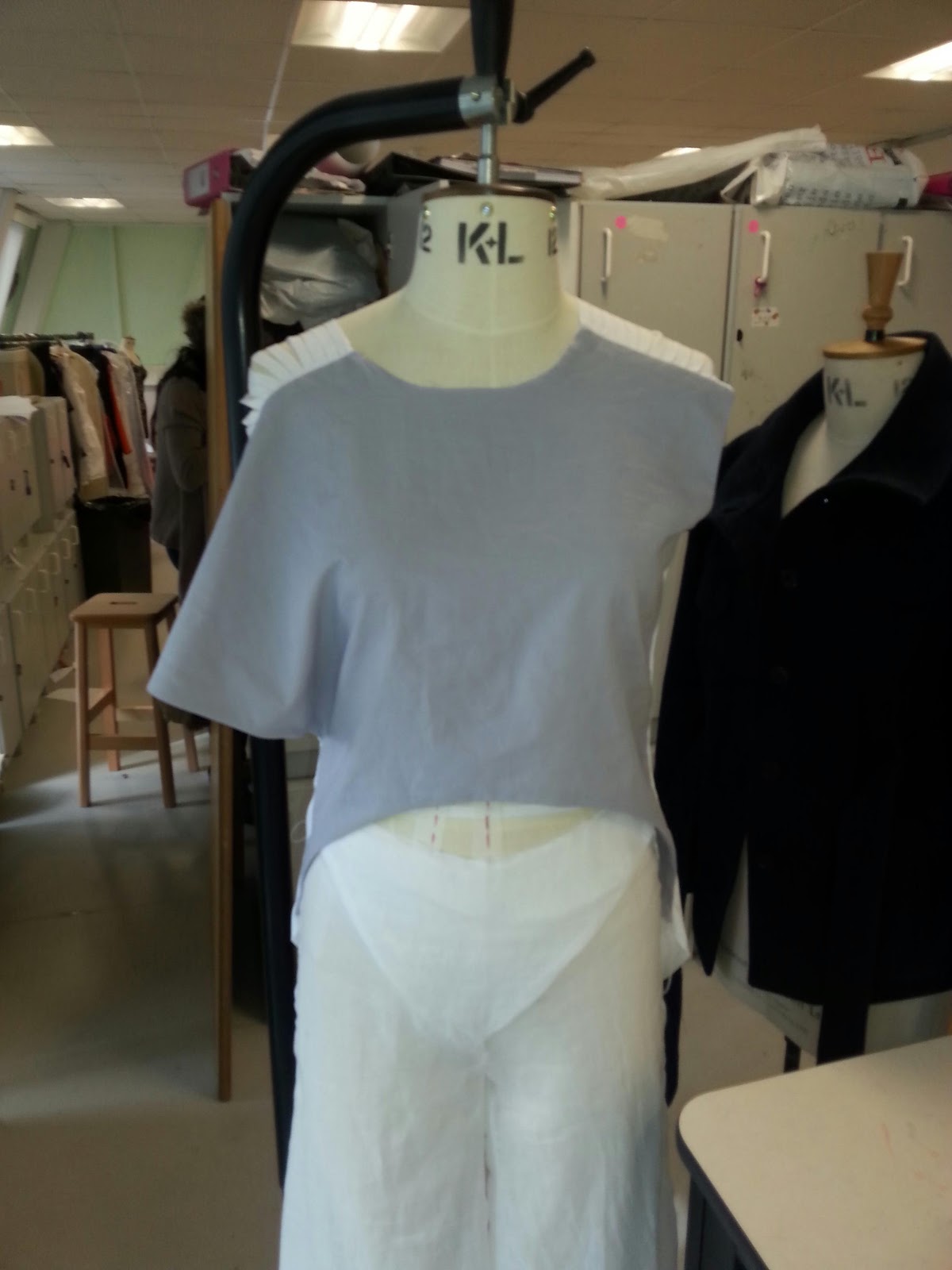
I have altered the top, amended the arm and shoulder, dropped the shoulder seam down the front and self lined the front in 100% cotton.
Much happier with the finish, toile complete!
Started drafting the trousers by slashing and opening a wide legged dropped waist block, I want the front to be like a wrap dress type opening so that it reflects the paper folding of origami, and I think it works, I will have to consider the facing and how to acheive it around the waistband with this way of opening the garment but I think the toile is nice.
Final thing to consider is whether I have an asymetric hem line on the trouser legs as per my design. During yhe crit it was suggested that I reconsider this hem kine when its toiled just in case the symmetry on the outfit becomes a little overly balanced.
Outfit two toile complete and I think I will use the top pattern to help sort the issues with outfit one, the short dress.

Final Major - Budellini technique

After visiting the Valentino exhibition I decided that I wanted to include some of the Couture techniques within my garment but at a more high street level. The one outfit I liked the most was a chiffon dress that used a technique known as Budellini
'Budellini (a couture technique specific to Valentino), where you start with a flat fabric, you roll sheep's wool into tubes, and then cover them with satin'
Valentino: Master of Couture' exhibition at Somerset House, London
By Apphia Michael
http://www.wallpaper.com/fashion/valentino-master-of-couture-exhibition-at-somerset-house-london/6215
I have looked into making these with something that has body like plastic tubing and although it looks nice its quite heavy, so I came across somee piping cord that shoild be used for piping around cushions when I was rooting around a haberdashers that was only 23p per meter and I used this with jersey overlocked to make a long narrow sock type cover and I fed it through.  I like this and will use it within the short dress at the front and the jersey top, like caging or scaffolding and the waistcoat maybe.

Final Major - Outfit 1 short dress

Started the toile for my short dress and I am not happy with it at all, its shapeless and very unattractive looking, not the look I was after. I have tried to pin it to give it more shape but there is still something wrong, I think I will move onto another outfit and come back to this one when I've thought about it some more.

Final Major - Draft Outfit 2 Top

The design i am working to is as attached
After making my first toile for the top I have decided that it is too shapeless and I want a little more structure.
I decided to change the neck line so that it was without polo styling and amend my long dress so that it was polo necked. Also improve the armhole as it seems to pull. Finally I will change the fabric at the front so that its 100% cotton, I will have to see how it looks if I self line the front but I will also have to look into having a seam across the front so that the shoulder weaving is still in the jersey one the front and back and remove the shoulder seam as I dont want a join in the middle of my weaving.
To do: amend pattern and re-toile

Monday, 25 February 2013

Final Major - Print

N. 21 Fall/Winter 2013-14 | Milan Fashion Week MFW | FashionTV 
The print on some of the designs shown by No21 at Milan Fashion week had a print that reminded me og the print design I am creating. It made me think about the placement of my print and that maybe to avoid an all over print and keep to placement in areas so improve its over all look.
I like the placement and how dramatic it looks when it is placed rather than the print being all over the fabric. Maybe look into minimizing the print on my designs to raise the drama.

Final major - fabric

I have visited fabric stores and flicked through websites for a while now hoping that something would leap out at me shouting couture budget  and it has been painful to say tbe least.
I visited a fabric shop on line that supplied cheap muslin. So I purchase some for sampling. Once it arrive I tested starch on it to see how it would work on the muslin. The results were pretty good and I though excellent, I have my fabric however after watching the the first episode of Signe Lagerfeld and learning that couture toiles are made of muslin tbe put my off using a toiling fabric for my collection. I want budget fabrics wih coutue designs made in a way that could be mass produced. Street Couture.
I liked the idea of using jersey/t-shirt fabric, a fabric that is more than often used by high street and perhaps tbought of as cheap. If I used fabric often used by high street and gave it a coutue makeover then I could get the look I am after. So I bought some £1.80 per metre white jersey.
Looking back through my sketchbook I liked tbe look of the scaffolding and weaving styles. I have played around with an old tshirt and I think my results could work within my design development.
Things to do - Design develop around jersey and the above technique

Tuesday, 12 February 2013

Starching Muslin - How far can you go????

Well after researching how to make muslin stiff, I have decided to start with spray starch. Dylon Starch. I have cut my muslin into 30cm squares and sprayed one so that it was stiffened, whilst keeping one plain, without starch. I then hemmed each on all four sides and folded and ironed it into an origami geometric pattern.
Firstly, the un-stiffened muslin:


It was floppy and lifeless, it didn't hold itself well even after ironing and when stitched to hold its shape it just lacked confidence.
The lines looked untidy at the centre and where all lines met it was uneven and lacked a professional look


Secondly, the stiffened muslin:

If was clean and sharp, it held together well after ironing. It was easier to mould so that the lines met cleanly at the centre and it gave the piece more volume and life.
It would need to be tested on dyed muslin also as there was a slight colour change when starch was added. I would also need to assess how much it would effect the dye and whether it would add to the dye running once I'd gained the pattern desired. I also want to see just how stiff I can achieve and how much starch that would require.

Valentino Exhibition

I have taken a trip to Somerset House and the Valentino: Master of Couture Exhibition - open until 3rd March. The exhibition displays dresses and outfits, designed by the house of Valentino, all couture and all very beautiful, stretching from the 1950's through to the 2000's. It displays many couture techniques along with videos of how these techniques are achieved, along with exerts from the Valentino virtual museum, which can be found at http://www.valentinogaravanimuseum.com/

The exhibition showed a total of 130 outfits, and although they each held a beauty that is un-levelled, my eye was drawn to a collection of outfits that displayed some interesting techniques that I would like to experiment with and see if they could be reproduced at high street level. Techniques that can be affordable for the everyday fashion fan.


Valentino's Haute Couture SS08 pale tulle evening suit with small appliquéd origami shapes, embroidered with tiny pink glass beads.

This idea could be assimilated into my designs, look into making muslin origami shapes that could be appliquéd onto outfit.
Look into playing with size and stiffness.


This Valentino dress, from the Haute Couture SS03 collection, has inserted transparent godets and is finished with beading around the arms.
Its an interesting idea to add a little transparency within the dress, this looks very revealing without allowing the wearer to feel naked. I also like the added beads around the arms, it gives a feeling of delicacy and softness, a little detail in a very otherwise simple yet glamorous design
I could use the idea of having a simple design with splashes of detail, this would enable the design to be beautiful and couture inspired yet keeps the cost down and so allows a high street price tag.
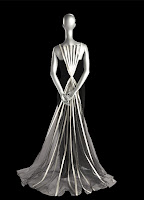


www.instyle.com
I like the detail of this Haute Couture Fall/Winter 1992/93 dress, worn by Julia Roberts to the 73rd Academy Awards on March 25th 2001.

The detail on the reverse of the dress is incredible, the idea of the ribbons the cascade down into a fan of material.

This idea could draw in the concept of structure within building scaffolding, it highlights the lines and brings an additional level to the shaping.

I would also like to look into the lines and how this could be used as it sits well with my theme of caging and scaffolding and structure.

This could also be seen in Valentino's Haute Couture SS1993 dress that uses a technique called budellini, which involves coating wool in a skin of chiffon, like long worms or sausages.
This is something I would like to look into using, but with something that has more body than wool. I have had a conversation with my husband and he suggested using windscreen washer tubing, so he has ordered me 3 metres and I will experiment with it, coating it in muslin.

I also like the idea of creating a collection that looks tactile, that has volume and makes you want to feel it.
Fall/Winter 2007/08
Valentino exhibited many outfits that made you want to touch, unfortunately that is out of the question, but that is not to say its not possible to recreate that feeling.
Fall/Winter 2007/08 had a technique called Paigine, which is hundreds of disks made of organza piled to create a pages of a book effect. This is interesting and could work with the edges of the origami squares that I can create.


Fall/Winter 1986/87
 Finally there were dresses that used a technique called Drappeggio, a couture technique with chiffon and crepe sild draped on the bias, the draping is done in gathers, with shades of colour to form a waterfall, rippling water effect.

Spring/Summer 1992
and a technique called 'Tappeto di ruches', which is a couture technique of strips of tulle sewn to a bias fabric to create a flat surface of tightly packed ruffles - (all Couture technique definitions have been taken from the guide book given at the exhibition).

All of these techniques called be experimented with to find a more high street technique, something more affordable.

From this exhibition, I will need to do quite a bit of experimenting and research into fabric properties and how colour will work with different processes

Sunday, 10 February 2013

Major project update

My sampling fabric has arrived, four metres of white muslin, so I went out and bought a can of starch. I am going to research the fabrics properties and what shapes can be acheived.  I can see what happens to its structure when a stiffening agent is added. I will also dye some too, this will help me understand how intense a colour change would be and it will give me an idea of shrinkage, as making the fabric wet may lead to the width or length shrinking.
I will start tomorrow, and I am looking forward to it!!!

Wednesday, 6 February 2013

Major Project

I have been considering fabrics for my Major Project.
The themes of my major project are structure, such as in buildings and scaffolding and caging, but also Origami within fabric manipulation. My concern is that this is quite a predictable theme, Origami has been done by fashion students and over done. I want my final outcome to be as far away from the usual Origami outcome as it can be, strive for something new and buck trend.
For these reasons I have been initially looking at satins and taffetas  this is a very obvious choice though and one that would be very predictable. I have therefore been looking into changing a fabrics properties by adding chemicals such as starch or even interfacing, and it has become very apparent that muslin can be manipulated quite easily. Muslin is 100% cotton and therefore also holds the potential to dye well. This could add another dimension to my design process, print. I like the idea of adding print and would love to work within print design in the future, so would be very beneficial to go through the process of print design for my major project.
I have ordered 4m of muslin in white to research what can be produced with this fabric, how it hems, how it can be folded and draped and how it can be dyed and starched.
If i do end up using this fabric I believe i will need an additional fabric that will work with the muslin but help provide another dimension to my work and also help provide additional structure where needed, ordering the 4m sampling fabric will provide me with a sample to shop with, helping make additional selection easier.


To Do:
Shop for additional fabric
Await delivery and then, dye it, hem it, starch it and drape it. Photos, photos, photos!!!! Samples, samples, samples!!!

Monday, 4 February 2013

Professional Practice - the outcome


A Critical Analysis of the Professional Practice Process

In reflection I believe I completed the exercise in the best way possible for me. Firstly I prepared my CV and portfolio so that I was sure they represent me in the best possible way, one is no good without the other when applying for a creative role. It is my belief that when you make your first contact with a potential employer, you need to bare in mind that it may only be the first contact of many before they actual pay attention and consider your requests seriously, it is therefore important to make sure that the impact you leave is a positive one. Maybe I will not hear back from any of the brands that I have contacted, but if I choose to apply for a position with the brand or the individuals that have viewed my submission again, in the future I may be remembered from my previous contacts, and if so, I want to ensure that the memory is positive one. This would require ensuring that the presentation of my efforts reflect me well and that all correspondences are consistent and of a professional standard, including being well thought-out and not look as if I have rushed the work. It is important that my CV and cover letter are creative, honest and well researched, which includes without error. That any work they may see is of the highest quality and reflects my abilities, whilst also showing my potential.

I learned a lot about researching from this process also, about researching a brand before writing the covering letter. This is something I didn’t understand until I followed the instructions and only then as I wrote my first covering letter did I see the importance and the power it can provide you with.

I now understand more about the companies I have researched, companies that I had assumed there was little left that I could learn about them, knowledge that will place me in good stead should I acquire an interview.

When it came to the format that I ended up sending the CV and portfolio in, I spent a long time  deliberating over whether it should be sent be email or by post, if I were to send it digitally, it would turn up immediately, without delay, it is a process that requires no finance to carry out and I can send almost all of my portfolio, however I would be unsure that the email was read or just discarded without any viewing, which is common with unsolicited emails within business. If I were to send it by post I can tailor make the entire package, my CV, covering letter and work can all reflect my creative flare. I can ensure that it stands out by using special paper, or writing style. I also think this process is harder to ignore, however it does have its drawbacks, It require a lot more work and it is very costly for printing.

I decided that a compromise was to send hard copies via the post but to send only a handful of images to each, making sure the ones I selected represent me accurately and that they were best suited to the brand I was writing to, a tailor made package, whilst ensuring the cover letter and CV highlight how my entire digital portfolio could be viewed. Although it is not the way I would wish to send them, it is still, in my opinion, better than emailing; it is more personal, more thought-out and shows an eye for detail and presentation. I think it represents me in a more positive manner. I am happy with the way in which I have carried out the process and look forward to the process when I have completed my studies and am ready to take on the working world again, at the end of April.
Not long now and hopefully this exercise will help as the companies I have contacted are all ones I would be very excited to work for.